
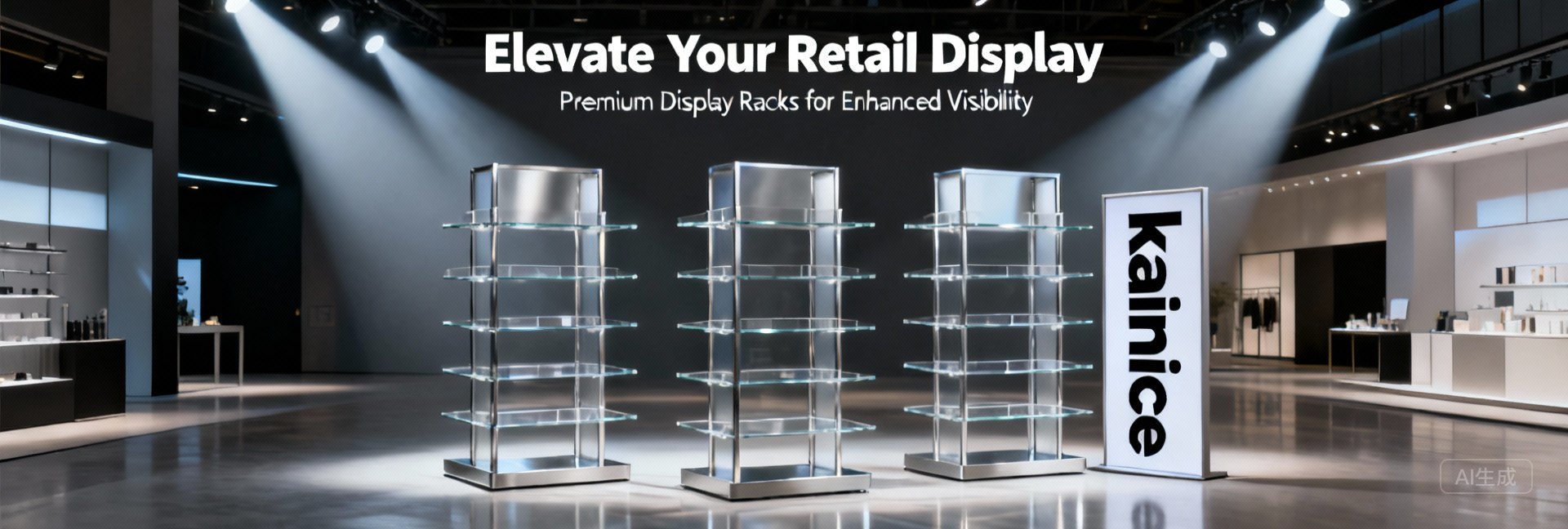
In high-traffic retail environments and modern commercial stores, selecting a heavy-duty, precision-crafted Retail Clothing Rack Wholesale directly impacts merchandise visibility and brand authority.
The Truth About Retail Display Engineering
I’ve spent 15 years on the shop floor, and I’ve seen more "bargain" racks collapse in the middle of a Saturday rush than I care to count. When you’re sourcing retail fixtures, you aren't just buying metal; you’re buying the safety of your customers and the integrity of your inventory. At kndisplay, we treat every rack like a structural bridge. If the math doesn't hold, the rack doesn't leave the factory.Retail Clothing Rack Wholesale Engineering: Avoiding Structural Sagging and Load Capacity Failures
Ever wonder why discount display racks start wobbling after two weeks? It’s rarely the design; it’s the gauge. Most wholesale racks on the market are built with 22-gauge steel tubing. That’s a mistake. For a standard clothing rack, 22-gauge is just too thin—it flexes under the weight of even a dozen heavy winter coats. I remember a client who tried to save a few bucks by ordering 0.8mm wall thickness racks for a high-end boutique. We warned them. Three weeks later, a joint failed under a maximum static load of 40kg, causing a cascading collapse that ruined $5,000 worth of cashmere sweaters. The fix? We replaced their entire inventory with our 1.5mm cold-rolled steel specification. At kndisplay, we enforce a strict 1.5mm to 2.0mm wall thickness for all load-bearing uprights. We perform static load tests where we hang 110lbs (50kg) per tier for 48 hours. If there is more than a 2mm deflection, we scrap the prototype. When you’re buying wholesale, don't let a supplier tell you "gauge doesn't matter." It is the difference between a fixture that lasts ten years and one that ends up in a scrap heap in ten days.Material Selection in Retail Clothing Rack Wholesale: Virgin Steel vs. Recycled Alloys
Here’s a secret the industry doesn't like to talk about: regrind. Many low-cost manufacturers use recycled steel alloys filled with impurities. You can’t see these impurities when the rack is new, but you’ll see them six months later when the powder coat starts bubbling or flaking off. Why does this happen? Because impurities in the metal prevent the powder coating from achieving a proper molecular bond. We use only high-grade, virgin cold-rolled steel. When we apply our 60-80μm (micron) thick powder coat, the finish is smooth, uniform, and incredibly resistant to the dings and scratches caused by hangers and customer interactions. I’ve seen "wholesale" racks arrive at stores with rust already forming under the paint because the factory used contaminated recycled scrap. Is saving $3 on material costs really worth the look of a rusted, peeling fixture in your store? High-carbon steel provides the rigidity needed for high-traffic environments, ensuring that your fixtures don't just look good on day one, but keep that showroom shine for years.Precision Manufacturing for Retail Clothing Rack Wholesale: Laser Tolerances vs. Manual Welding
Manual welding is a craft, but in mass production, it’s a liability. If you have a welder eyeballing the angle of your uprights, you’re going to get variations. Even a 2-degree tilt in a base plate leads to a "wobbling" rack that never sits flat on a retail floor. At kndisplay, we utilize CNC laser cutting with tolerances held to ±0.1mm. This precision allows for a "snap-fit" or "bolt-lock" assembly that is rock solid. When the laser cuts are precise, the joints sit perfectly flush. When the joints are flush, the load is distributed evenly across the frame rather than stressing a single weld point. We’ve seen competitors who rely on manual jigs; their racks often arrive with bent brackets or holes that don't line up. You end up spending hours on the shop floor with a drill and a hammer just to make the thing stand up straight. That’s not manufacturing; that’s a headache. Precision engineering means your team can assemble a 50-rack store rollout in an afternoon, not a week.Cost Breakdown and Logistics in Retail Clothing Rack Wholesale: Preventing Freight Damage and Hidden Fees
Shipping is where most wholesale deals go south. If a rack isn't engineered for shipping, it arrives looking like it went ten rounds in a boxing ring. We’ve spent years refining our flat-pack designs to optimize for volumetric weight without sacrificing structural integrity. A common failure is "shipping fatigue." This happens when thin-walled tubes are bundled together without proper internal reinforcement; the vibration during transit causes the metal to dent or the powder coat to rub off against the neighboring piece. We use custom-molded pearl foam inserts and double-wall corrugated cardboard to ensure every component is isolated."If the packaging isn't as engineered as the product, you’ve already lost the battle before the box is opened."When you’re sourcing wholesale, ask about the packaging protocols. Are they using standard bubble wrap, or are they using precision-cut foam? Do they include a hardware kit with 10% extra fasteners? I’ve seen projects delayed by weeks because a supplier forgot a single type of M6 bolt. At kndisplay, we double-check every hardware pack against a digital scale to ensure the count is perfect. It’s these small, boring details that keep your store opening on schedule and your budget intact. Don't fall for the lowest quote if it doesn't include a freight-damage guarantee. Cheap shipping is just a down payment on a damaged shipment.

[Figure] Retail Clothing Rack Wholesale commercial showroom deployment & structural details (Fabrication: kndisplay)
Scene: High-end commercial boutique showroom featuring custom heavy-duty Retail Clothing Rack Wholesale (Clothing & Garment Display Racks) with precision diamond-polished finish, 3000K warm directional spotlights, neatly organized merchandise, and 8k architectural photography.
💡 Factory Veteran Tip:
Every retail chain and storefront layout has distinct footprint constraints and load-bearing requirements. Before signing off on bulk Retail Clothing Rack Wholesale manufacturing orders, always demand certified load analysis drawings and a physical sample evaluation. At kndisplay, our engineering team provides free prototype evaluations and B2B fixture consulting for brands worldwide.