
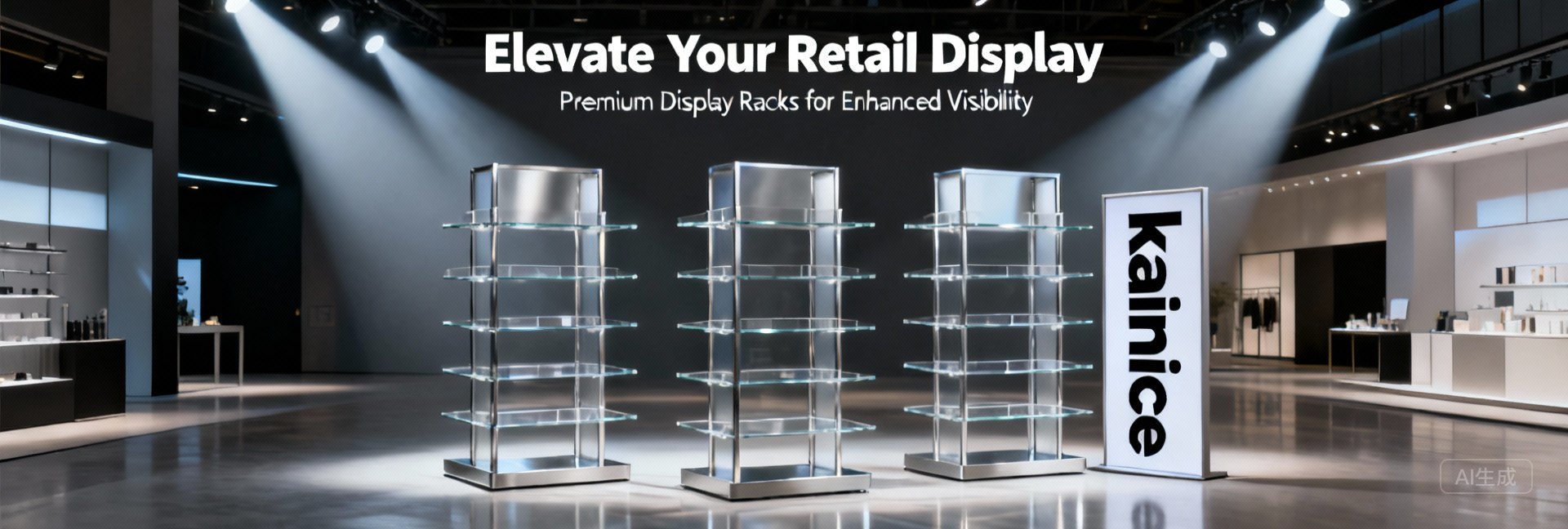
In high-traffic retail environments and modern commercial stores, selecting a heavy-duty, precision-crafted Stainless Steel Apparel Rack directly impacts merchandise visibility and brand authority.
Mastering the Craft: The Reality of Stainless Steel Retail Fixtures
I’ve spent 15 years on the shop floor, and if there’s one thing I’ve learned, it’s that a retail display isn’t just furniture—it’s a silent salesperson. When that salesperson collapses under the weight of a heavy winter coat collection, your brand image goes down with it. I’ve seen it happen. I once walked into a high-end boutique where a budget-grade rack had buckled, dumping three dozen cashmere sweaters onto a dusty floor. The manager was mortified. That’s why at kndisplay, we don't just "build" racks; we engineer them to withstand the absolute worst-case scenarios of a high-traffic retail environment.Stainless Steel Apparel Rack Engineering: Hot-Bending vs Cold-Forming Tolerances
The debate between hot-bending and cold-forming is settled in my book: if you want a rack that lasts, you cold-form. Hot-bending might be cheaper and easier on the equipment, but it ruins the game. When you heat stainless steel to extreme temperatures to force a bend, you are fundamentally altering the grain structure of the metal. You’re essentially "cooking" the corrosion resistance out of the steel right at the stress point. In our shop, we use precision cold-forming. We maintain tolerances of ±0.2mm. Why? Because when you cold-form, you keep the molecular structure tight. I once saw a major retail chain lose an entire floor set because they sourced racks from a manufacturer who took the hot-bend shortcut. Within six months, the weld points adjacent to the bends started showing microscopic stress fractures. Those fractures turned into deep fissures, and eventually, the structural integrity snapped. At kndisplay, our engineering protocol mandates cold-forming for all primary load-bearing members. It takes more machine power and more expensive tooling, but it ensures the material stays uniform. If you’re looking at a rack that has heat-discoloration marks at the joints, run the other way. That’s a ticking time bomb for your retail floor.Preventing Stainless Steel Apparel Rack Sagging Through Load Capacity Testing
Ever wonder why discount display racks start wobbling after two weeks? It’s almost always a failure in wall thickness and joint reinforcement. Most "off-the-shelf" racks use 22-gauge or even 24-gauge tubing. That’s paper-thin. Under a load of 30kg, that metal will start to bow within days. We don't play those games. We stick to a minimum of 1.5mm wall thickness for horizontal bars. I’ve personally oversaw 24-hour static load tests where we hang 110lbs (50kg) on a 1.2-meter span. We measure the deflection with a dial indicator. If the bar bows more than 2mm, it doesn't leave the factory floor. The secret isn't just the thickness; it’s the internal gusseting. We use CNC-machined inserts at the connection points. Think of it like a bone joint—if the connection is loose, the whole structure fails. When we design a fixture for a client, we calculate the "moment of inertia" for the specific tube geometry. If you’re buying racks, ask the manufacturer for their load-test data. If they don't have it, they aren't manufacturers—they’re just assemblers. Is saving $3 on metal gauge really worth a $10,000 product spill on your sales floor?Stainless Steel Apparel Rack Material Selection: Avoiding Grade 201 vs 304 Pitfalls
This is the industry's dirtiest secret. Many suppliers will sell you "Stainless Steel" that is actually Grade 201. It looks like 304, it feels like 304, but it has a lower nickel content and a higher manganese content. In a climate-controlled office, 201 might hold up. In a busy store with humidity, sweat, and cleaning chemicals? It will oxidize. I’ve seen "304" racks develop rust spots within three months because the manufacturer used "regrind" or low-nickel scrap steel to cut costs. At kndisplay, we use a handheld XRF analyzer to verify the alloy composition of every single shipment of raw tubing. If it doesn't hit the 8-10% nickel threshold required for 304, it gets rejected. How can you tell the difference? Take a magnet. Grade 304 should have virtually zero magnetic pull. If your "stainless" rack is attracting a magnet like a refrigerator door, you’ve been sold a low-grade substitute. Don't let a salesperson tell you that "all stainless is magnetic." That’s a lie designed to offload cheap, high-iron content steel onto your balance sheet.Reducing Freight Damage in Stainless Steel Apparel Rack Shipping and Assembly
The last thing you want is a beautiful, custom-engineered rack arriving at your store looking like it went through a blender. Shipping retail fixtures is where most manufacturers fail. They use thin cardboard, no internal bracing, and hope for the best. We approach packaging with the same engineering rigor as the rack itself. We utilize modular knock-down (KD) joints that are hidden and reinforced. Instead of flimsy plastic clips, we use high-tensile steel bolts that seat into threaded inserts. This prevents the "wobble factor" that ruins so many KD designs. For protection, we use custom-cut pearl foam blocks. We perform a drop test from 1 meter on every new packaging configuration. If a corner of the rack dents or the powder coat (we aim for a 60-80μm thickness for maximum scratch resistance) flakes off, we redesign the box. I’ve had clients tell me they switched to us simply because they were tired of spending three hours with a touch-up pen every time a shipment arrived. When you invest in high-end stainless, the packaging should be the last thing you worry about. If your manufacturer is shipping in thin, single-wall boxes with bubble wrap, they are cutting corners on your investment. Demand double-wall corrugated, demand internal bracing, and demand a fixture that arrives ready to assemble without a single scratch.
[Figure] Stainless Steel Apparel Rack commercial showroom deployment & structural details (Fabrication: kndisplay)
Scene: High-end commercial boutique showroom featuring custom heavy-duty Stainless Steel Apparel Rack (Clothing & Garment Display Racks) with precision diamond-polished finish, 3000K warm directional spotlights, neatly organized merchandise, and 8k architectural photography.
💡 Factory Veteran Tip:
Every retail chain and storefront layout has distinct footprint constraints and load-bearing requirements. Before signing off on bulk Stainless Steel Apparel Rack manufacturing orders, always demand certified load analysis drawings and a physical sample evaluation. At kndisplay, our engineering team provides free prototype evaluations and B2B fixture consulting for brands worldwide.