
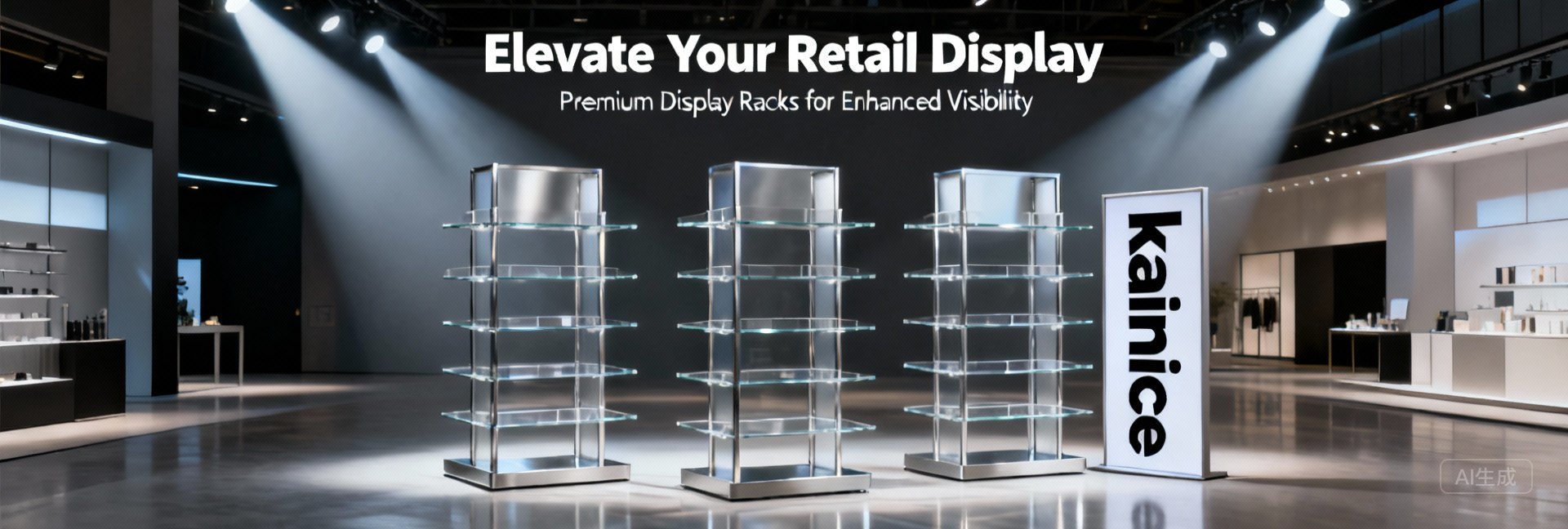
In high-traffic retail environments and modern commercial stores, selecting a heavy-duty, precision-crafted Hangrod Display Rack directly impacts merchandise visibility and brand authority.
The Reality of Retail Fixture Engineering
I’ve spent fifteen years on the factory floor, and if there’s one thing I’ve learned, it’s that a hangrod display rack isn’t just a piece of metal—it’s the backbone of your revenue. If your rack fails, your merchandise ends up on the floor, and your customers walk away. I’ve seen too many retailers try to save a few bucks on low-gauge steel, only to watch their inventory drag the entire fixture into a permanent, unsightly bow. At kndisplay, we don’t build for "good enough." We build for the reality of a busy retail store where a rack might hold 50kg of winter coats and get bumped by a shopping cart a dozen times a day.Preventing Hangrod Display Rack Sagging Through Proper Material Gauge Selection
Ever wonder why discount display racks start wobbling after two weeks? It’s almost always a failure in material selection. Most cheap racks use 22-gauge or even 24-gauge steel tubing. That’s a mistake. When you hang a row of heavy denim or winter parkas, that thin metal hits its elastic limit immediately. At kndisplay, we enforce a strict minimum of 16-gauge (1.5mm) cold-rolled steel for primary load-bearing hangrods. For longer spans exceeding 1200mm, we move up to 14-gauge (2.0mm) to prevent deflection. I remember a client who insisted on using 18-gauge for a 1500mm span. We warned them, but they wanted to cut costs. Three months later, the racks were sagging like a hammock. The cost of replacing those units was triple what they would have spent on the correct gauge in the first place. Cold-rolled steel is superior to aluminum extrusions for high-traffic hangrod applications. Aluminum is great for aesthetics, but it lacks the yield strength of steel. If you’re displaying heavy merchandise, stick to steel. It’s harder to work with, it’s heavier to ship, but it doesn’t bend under pressure. Is saving $3 on metal gauge really worth a $10,000 product spill when a rack collapses on a customer? Don't do it.Laser Tolerances vs Cold-Forming: Engineering a Durable Hangrod Display Rack
Precision isn’t just about making things look pretty; it’s about structural integrity. When we use CNC laser cutting, we hold tolerances to ±0.2mm. Why does that matter? Because if your mounting holes don’t align perfectly with your uprights, you’re introducing "slop" into the assembly. That slop is where vibration starts, and vibration is the silent killer of retail fixtures. Cold-forming metal—like bending tubes or stamping brackets—can introduce micro-fractures if the tooling isn’t calibrated correctly. I’ve seen cheap manufacturers bend metal until it turns white at the crease. That’s a stress fracture waiting to happen. On the shop floor, we monitor weld penetration depth religiously. For a load-bearing joint, we look for 100% penetration, not just a surface tack weld that looks clean but snaps the moment a rack is loaded. If you’re sourcing fixtures, ask the manufacturer about their laser tolerances. If they can’t give you a number, run. At kndisplay, we use laser cutting to ensure that every bolt sits flush and every joint is tight. A tight joint doesn't rattle. A rattling rack is a cheap rack that will eventually fatigue at the connection point.Hangrod Display Rack Load Capacity Testing and Weight Distribution Failures
We don’t just guess at capacity. Every design goes through a static load test in our workshop. We hang weights until the structure shows signs of deformation. We differentiate between static load—the weight sitting there—and dynamic load, which is what happens when a customer yanks a hanger off the rack. The most common failure point is the bracket-to-upright connection. If the bracket is flimsy, the weight of the clothes acts as a lever, pulling the bracket away from the upright. We use reinforced gussets on all our brackets to redirect that force downward. I once had a retail chain return a shipment because the racks were "collapsing." When we analyzed the failed units, we found they weren't actually collapsing; the brackets were twisting because the factory they’d used previously had used screws that were too short to engage the core of the upright. We replaced them with heavy-duty, through-bolt hardware. The difference in stability was night and day. Over-engineering your connection points is the cheapest insurance policy you can buy.Reducing Freight Damage in Hangrod Display Rack Logistics and Flat-Pack Assembly
Shipping is where most fixtures die. If your packaging is weak, your powder coat will be chipped before it even hits your sales floor. We’ve moved away from standard cardboard boxes to a double-walled, pearl-foam-lined packaging system. When you’re designing for KD (Knock-Down) assembly, the challenge is keeping the parts count low while keeping the structure rigid. Every extra bolt is a potential point of failure. We use pre-installed threaded inserts—not just self-tapping screws—to ensure that the rack can be assembled and disassembled repeatedly without stripping the threads. If you’re a retailer assembling these on-site, here’s a pro tip: use a manual socket wrench, not an impact drill. I’ve seen too many store managers strip a rack’s hardware because they wanted to save ten minutes. A stripped thread is a loose rack, and a loose rack is a liability. Our kndisplay engineering benchmarks require that all hardware be grade 8.8 steel or higher to ensure that even if someone over-torques a bolt, the bolt won't snap. Regarding the finish, we insist on a powder-coat thickness of 60-80μm. Anything less, and you’ll see the metal through the paint after a few months of hangers scraping against it. We also bake our powder coat at 200°C for a full cure cycle. It’s the only way to ensure the finish can survive the abuse of a busy retail environment. If the finish is soft, the rack is already failing. Treat your fixtures like the expensive assets they are, and they’ll hold your inventory for years.
[Figure] Hangrod Display Rack commercial showroom deployment & structural details (Fabrication: kndisplay)
Scene: Commercial retail showroom featuring custom heavy-duty Hangrod Display Rack with diamond-polished edges, 3000K directional spotlights, and organized merchandise, 8k architectural product photography.
💡 Factory Veteran Tip:
Every retail chain and storefront layout has distinct footprint constraints and load-bearing requirements. Before signing off on bulk Hangrod Display Rack manufacturing orders, always demand certified load analysis drawings and a physical sample evaluation. At kndisplay, our engineering team provides free prototype evaluations and B2B fixture consulting for brands worldwide.