

If you've been in retail procurement for more than a minute, you already know the headache of sourcing a reliable corrugated display rack that won't buckle under your own inventory. Fifteen years in this business means I've spent countless hours arguing with factories, squinting at fluted cardboard, and watching gorgeous point-of-purchase units turn into soggy cardboard soup right on the store floor. Pull up a chair. Let's talk about what actually matters when you're buying these things in bulk.
What is the realistic unit cost and MOQ for a custom corrugated display rack?
Online pricing is almost always a joke. I was reviewing supplier data out of Qingdao just last week—they were quoting $0.21 to $0.25 USD a pop for a basic cosmetic perfume display. Sounds great, right? Except it comes with a massive Minimum Order Quantity (MOQ) of 500 sets. Need something beefier? Say, a foldable eco-friendly stand for a trade show? Xi'an suppliers will quote you anywhere from $45 to $450 USD per set, sometimes dropping the MOQ down to a single unit.
Here is the reality check, though. That dirt-cheap $0.21 unit? It's tiny. It uses single-wall E-flute or F-flute cardboard and holds maybe three lipsticks. You want a full-sized floor stand for 50 bottles of shampoo? Expect to pay $8 to $18 USD per unit, usually at an MOQ of 200 to 300 pieces. Never let a supplier lowball you on a basic counter-top piece just to jack up the price on the floor model.
How do you verify the structural integrity and load-bearing capacity of a corrugated cardboard display stand?
This is exactly where most buyers get burned. They stare at a pretty 3D rendering and assume it will easily hold 100 pounds of canned goods. Spoiler alert: it won't. You have to demand a bursting strength test and an edge crush test (ECT) report from your supplier before signing anything.
I drill this into my clients: specify the exact material grade. For a standard retail floor unit, you need at least B-flute combined with E-flute (BE flute) for the main structural pillars. That combo gives you the rigidity of the B-flute plus the smooth printing surface of the E-flute. If a supplier tries to hand you a certificate for standard single-wall C-flute and claims it's fine for a heavy display, walk out. I had a client in Texas whose display collapsed on day two because the factory secretly swapped BE flute for cheaper B-flute to save a few cents. Never, ever skip pre-shipment sample approval.
What are the common customization traps buyers fall into when ordering printed corrugated point-of-purchase displays?
Printing on corrugated material is an entirely different beast compared to standard paperboard. The biggest trap I see? Buyers assuming their digital CMYK file will look identical on brown kraft cardboard. It won't. That porous surface drinks up the ink, leaving you with dull, muddy colors.
Want vibrant, high-end graphics for a premium cosmetics launch? You need to insist on offset printing on white coated paper, which is then mounted onto the corrugated board. Sure, it runs about 15% to 20% more than direct flexo printing. But direct flexo on uncoated board makes a luxury brand look like a dollar store discount bin. Also, always ask for a matte or gloss aqueous coating. Skip that, and the ink will scuff right off the second a store clerk tries to wipe down the display.
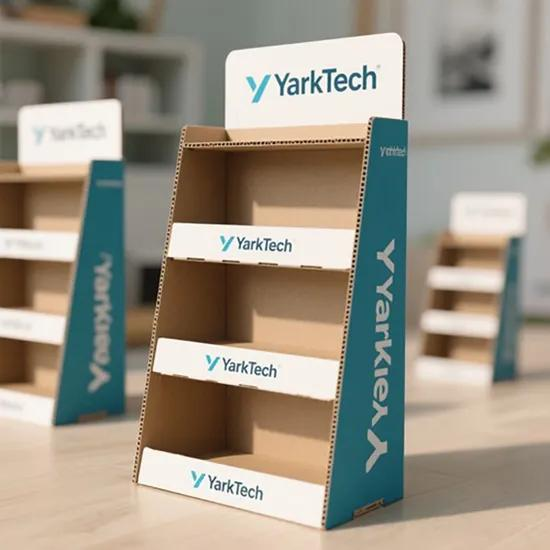
How long does actual production and shipping take for a bulk order of eco-friendly corrugated retail fixtures?
Factories love promising a 12-day production time just to win your business. Take that with a massive grain of salt. For a standard order of 1,000 units with custom printing, a realistic production lead time is actually 15 to 20 days. That covers structural sampling, print proofing, mass production, and quality control.
Then you have to factor in shipping. Sea freight from China to the US West Coast? Add 18 to 25 days. East Coast? Tack on another 10 days. Your total lead time from PO placement to warehouse delivery is easily 45 to 60 days. I always tell procurement managers to build a two-week buffer into their timeline. If your promotional campaign kicks off November 1st, those goods need to be on the water by early September.
What red flags should I look for when vetting overseas suppliers for corrugated floor display racks?
Scroll through Alibaba or Made-in-China and you'll find thousands of suppliers. Half of them are just trading companies slapping a 20% margin on a factory's price. How do you spot the middlemen? Look at their business license and watch out for these specific warning signs:
- Mismatched business scopes: If their license includes hardware, plastics, or textiles right alongside cardboard displays, they're a middleman.
- Missing certifications: A real factory will hand over ISO 9001 and FSC docs upfront without blinking.
- Refusal to video call: If they can't show you their die-cutting machines and corrugated laminators live, they don't own the production line.
If they stall on the certificates or send over a blurry photo that doesn't match their company name, run. A legitimate manufacturer is proud of their equipment and will gladly show it off.
Why do my corrugated display units keep failing or warping once they hit the retail floor?
This is the most frustrating issue I deal with on a weekly basis. You get a perfect sample, approve it, and then the bulk shipment arrives looking like it was left out in a monsoon. Units warping on the floor? Sound familiar? The culprit is almost always humidity during transit or botched assembly at the store level.
First, make sure your supplier uses desiccants inside every master carton and wraps the pallets in heavy-duty plastic. Sea containers can hit 80% humidity, and cardboard acts like a giant sponge. Second, look at your assembly instructions. If your display requires a store clerk to glue tabs or fold complex interlocking joints, they're going to mess it up. I always design displays to be pre-glued at the factory so they just pop open and lock into place. It saves you the absolute nightmare of replacing warped units just because a tired retail employee folded the bottom panel backward.