
Why the Right Garment Rack Is a Sales Tool, Not Just a Fixture
Walk into any well-run clothing store and notice what you see first: the fixtures. A well-chosen Garment Rack does far more than hold hangers in place. It guides customer flow, keeps garments in pristine condition, puts new arrivals at eye level, and quietly signals product quality before a shopper touches anything. For retail store owners, brand buyers, and wholesalers, rack selection is one of the highest-return decisions in store planning — effective visual merchandising measurably lifts impulse purchases, and racks are where that merchandising happens.
This guide breaks down the main rack types, the materials and load specifications that matter in commercial settings, the difference between commercial and home-grade fixtures, and the buying points B2B purchasers should confirm before placing an order.
Main Types of Garment Racks for Retail Displays
Different merchandising goals call for different structures. The most common formats include:
- Single-rail racks: One horizontal bar on a metal or wood frame. Clean, breathable presentation for boutiques, new arrivals, and capsule collections.
- Double-rail racks: Two hanging levels that double capacity within the same footprint. Ideal for basics, children's wear, uniforms, and high-SKU outlet zones.
- Four-way racks: Four display arms on a central post, allowing face-out presentation of complete outfits from every direction. A strong mid-floor focal point.
- Round racks: A circular rail on a weighted base with 360-degree browsing access. High density for sale areas and clearance zones.
- Wall-mounted garment racks: Rails, face-out arms, and shelves fixed to walls or slatwall panels. They free up floor space and keep narrow boutiques feeling open.
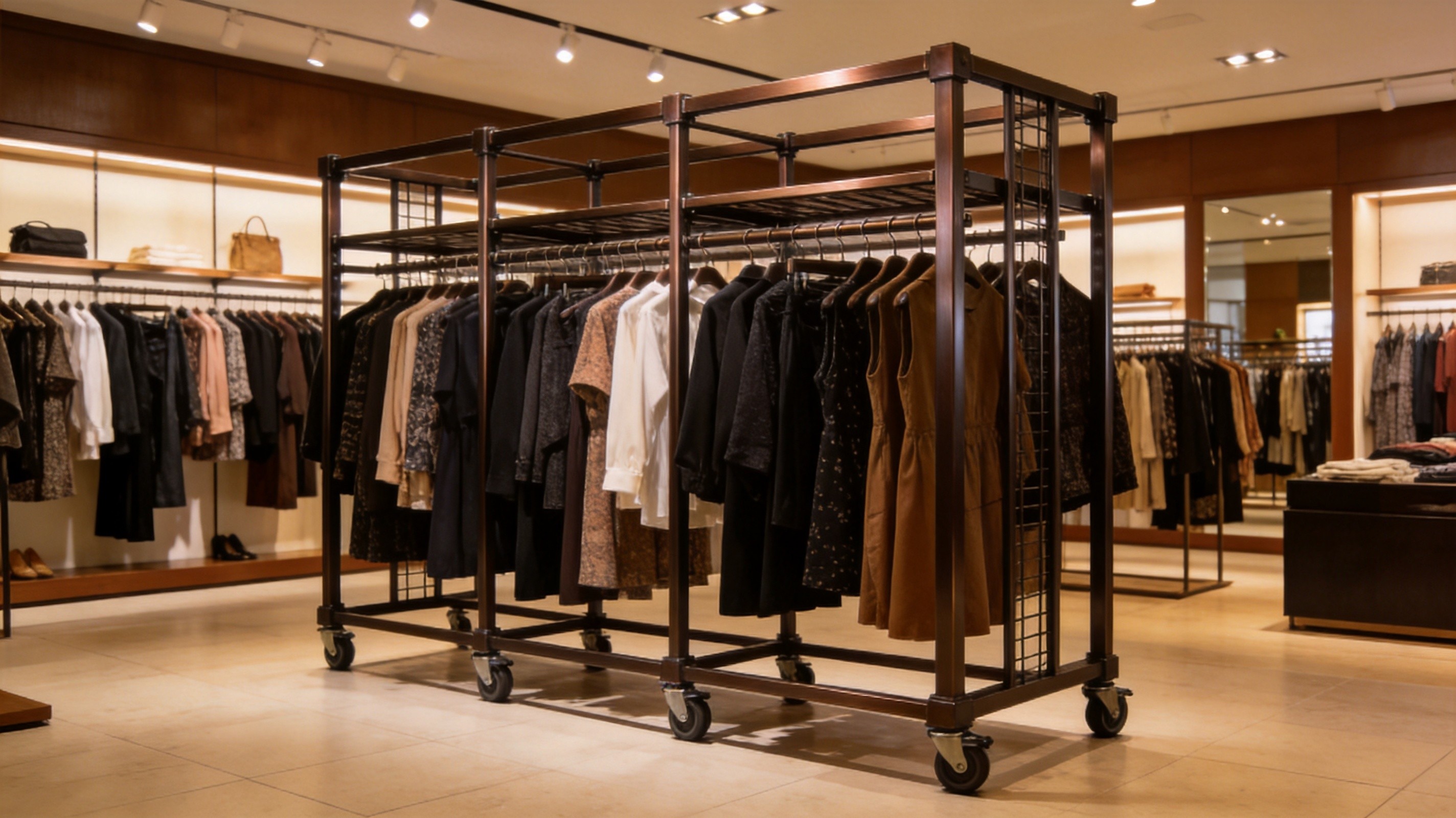
- Rolling garment rack units: Mobile frames on casters for stock rotation, back-of-house transport, pop-up shops, and fast seasonal resets.
Most successful stores combine two or three rack types rather than relying on a single format. A typical layout uses four-way racks near the entrance to present hero looks, wall systems along the perimeter for depth, and round or double-rail units in high-density zones. Keeping rail heights consistent and leaving negative space between fixtures makes the entire floor easier for shoppers to read.
Materials and Weight Capacity: The Specs That Decide Longevity
Material choice shapes both lifespan and brand perception. Powder-coated steel is the industry standard for commercial fixtures: it carries heavy loads, resists scratches and corrosion, and accepts virtually any brand color. Stainless steel offers a brighter, premium finish; solid wood and veneer add warmth to boutique interiors; acrylic and glass suit high-end, product-first displays.
Weight capacity is the non-negotiable specification. Standard racks typically support 100–200 lbs (45–90 kg), while a properly engineered heavy duty garment rack uses thicker-gauge tubing and reinforced welded joints to carry dense outerwear, denim, and suit programs without bending. Professional buyers should request rated load data from the manufacturer and apply a safety margin of roughly 1.5× for daily operation, especially on long-span rails and winter collections.
- Check bar gauge against rail length — longer spans need stronger tubing to avoid visible deflection.
- Prefer welded or securely fastened joints over loose snap-fit connections.
- Confirm base stability: weighted or floor-fixable bases prevent tipping on fully loaded rounders.
- On wheeled units, insist on locking casters and non-marking wheels.
- Plan quarterly checks of joints, casters, and coating touch-ups to extend service life.
Commercial vs. Home Use: Why the Difference Matters
A residential clothes rack is built for occasional access. A commercial garment rack is engineered for a different reality: hundreds of customer touches per day, constant restocking, repeated reconfiguration, and heavy foot traffic. The difference shows up in frame thickness, joint construction, base weight, and finish durability — not necessarily in how the rack looks in a product photo.
Saving money with home-grade fixtures usually costs more over time. Wobbling uprights, bent rails, and chipped coatings drag down the perceived value of the garments hanging on them. Commercial-grade units cost more upfront yet deliver years of stable service, which is why wholesalers and chain retailers consistently specify commercial standards for multi-store rollouts.
Key Buying Points Before You Place an Order
Whether you are outfitting a single boutique or sourcing fixtures for a chain, work through this checklist first:
- Measure the space: Map aisles, door swings, and fire exits. Keep roughly 36 inches (1.2 m) between fixtures for comfortable browsing.
- Match rack to merchandise: Heavy coats need reinforced frames; lightweight blouses need spacing that keeps displays looking tidy.
- Lock in one finish family: Matte black, chrome, brushed brass, or wood grain should echo your brand identity — too many mixed finishes create visual noise.
- Prioritize flexibility: Adjustable arms, removable shelves, and modular add-ons keep fixtures useful as assortments change each season.
- Confirm packing and assembly: Knock-down packing reduces shipping volume; pre-assembled units save on-site labor. Decide which fits your project.
- Verify safety compliance: Keep exit routes clear, engage caster brakes when stationary, and anchor tall units to walls where required.
Sourcing From an OEM/ODM Garment Rack Manufacturer
For B2B buyers, the factory behind the product matters as much as the product itself. Buying garment rack wholesale through an experienced OEM/ODM manufacturer gives you control over dimensions, load ratings, powder-coat colors, logo plates, and packaging — options that off-the-shelf imports rarely match. It also matters at scale: when one design must be reproduced consistently across dozens or hundreds of stores, factory-standardized production and store-by-store packing prevent expensive inconsistencies. A manufacturer with in-house metal fabrication and powder-coating lines, such as Xiamen Kainice (xmkainice.com), can shorten sample cycles and keep quality stable from prototype through full container orders.
When evaluating a custom garment rack supplier, ask a few direct questions before committing to a purchase order:
- Can they provide engineering drawings and rated load data, not just catalog photos?
- What is the MOQ, and can material and finish samples be supplied before mass production?
- Do they support brand-color powder coating, engraved logo plates, and custom signage holders?
- How is knock-down packing organized and labeled for multi-store rollouts?
- Which processes — cutting, welding, powder coating, assembly — are handled in-house?