
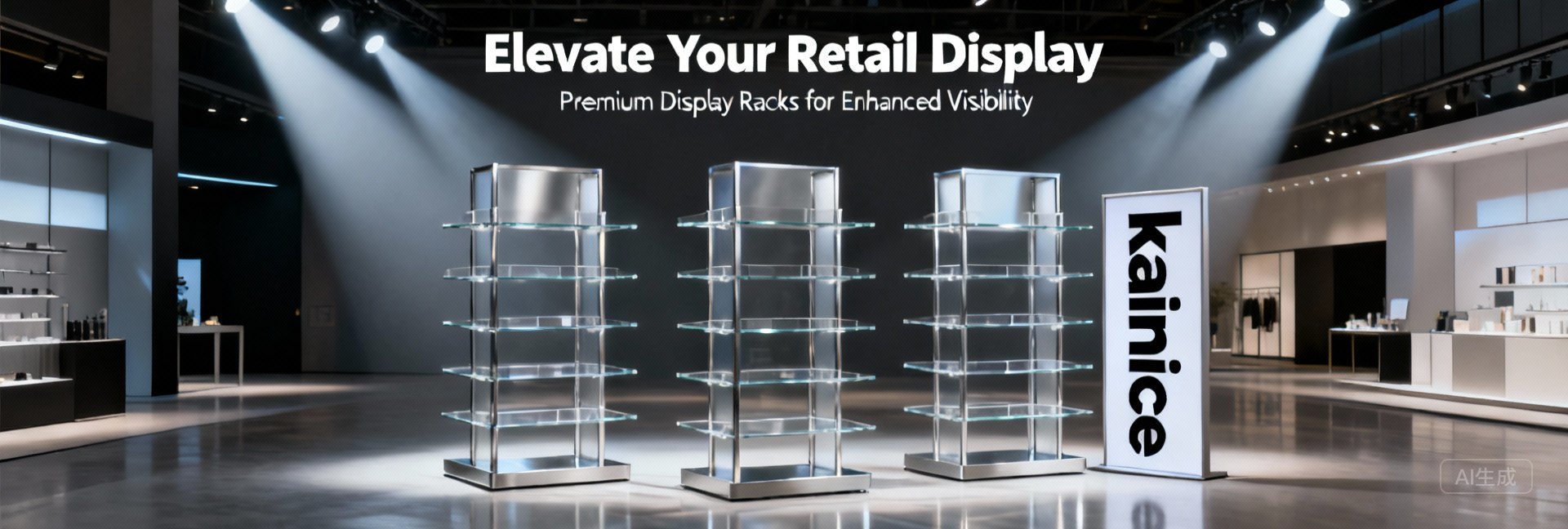
In high-traffic retail environments and modern commercial stores, selecting a heavy-duty, precision-crafted ODM Garment Rack directly impacts merchandise visibility and brand authority.
The Reality of Manufacturing Custom Retail Fixtures
I’ve spent 15 years on the factory floor, and if there is one thing I’ve learned, it’s that a garment rack is not just a piece of metal. It is the silent salesperson of your retail space. When you order an ODM garment rack, you aren't just buying steel; you are buying the assurance that your high-end inventory won’t end up in a heap on the floor on a busy Saturday afternoon. I’ve seen it happen. I once walked into a client’s shop to find a display of heavy winter parkas had completely buckled a low-grade rack, snapping the welds like dry twigs. It wasn't the weight of the coats; it was the ego of the factory that tried to save pennies on steel gauge. At kndisplay, we don't play those games. We enforce a strict quality standard that treats every rack as if it were holding a $50,000 inventory. If you are sourcing custom fixtures, you need to understand the physics behind the metal.ODM Garment Rack material selection: avoiding structural failure and sagging
The most common shortcut I see in this industry is the use of regrind scrap metal. It’s cheap, it’s easy to source, and it’s a disaster waiting to happen. Virgin cold-rolled steel is the only material that should ever touch an ODM garment rack. Why? Because virgin steel has a consistent grain structure. Regrind, on the other hand, is essentially a mystery alloy with weak points that you can’t see until the rack is fully loaded. Here’s the breakdown: most "budget" racks use 22-gauge (approx. 0.7mm) tubing. That is essentially sheet metal folded into a shape. It will sag under the weight of even a dozen denim jackets. We insist on nothing less than 16-gauge (1.5mm) for uprights and 14-gauge (2.0mm) for load-bearing crossbars. Ever wonder why discount display racks start wobbling after two weeks? It’s because the steel is too thin to resist torsional force. When a customer yanks a hanger off, the rack twists. Over time, that twist becomes a permanent bend. At kndisplay, we mandate a minimum 1.5mm wall thickness for all structural uprights. If you’re displaying heavy winter coats, don't even think about going below 2.0mm. Is saving $3 on metal gauge really worth a $10,000 product spill?Precision engineering for ODM Garment Rack: laser tolerances vs manual welding
In the old days, we relied on manual measurement and jig-based cutting. Those days are gone. Today, if your laser cutting tolerances are wider than ±0.2mm, you are going to have a bad time. I’ve seen racks where the holes for the bolts were off by a mere millimeter, forcing the floor team to hammer the bolts into place. That creates stress points that will eventually crack the powder coating. The kicker is the heat-affected zone (HAZ) caused by sloppy welding. When a welder spends too much time on one joint, the intense heat ruins the temper of the surrounding steel, making it brittle. That’s why we use CNC fiber laser cutting for every profile. It gives us clean, surgical edges that fit together like a puzzle. When we assemble a rack, the pieces should slot together with zero resistance. If you have to force it, the engineering is flawed. Furthermore, we use robotic pulse-welding where possible to minimize heat input. This keeps the steel strong and ensures that when we apply our 60-80μm thick powder coat, the surface is perfectly smooth. If the weld is too hot and the metal warps, the powder coating will eventually flake off at the joint. That’s a sign of a factory that doesn't care about the final look of your store.Hot-bending vs cold-forming techniques in ODM Garment Rack manufacturing
People often ask me if they should choose a rack with sharp, cold-formed angles or soft, hot-bent curves. It’s a design choice, but it’s also a structural one. Cold-forming, or bending the metal at room temperature, creates immense internal stress at the bend. If you are using inferior steel, those bends are exactly where the rack will snap under dynamic load. If you need a high-end, curved look, induction hot-bending is the gold standard. By heating the steel to a precise temperature before bending, we eliminate the internal tension. It keeps the structural consistency of the tube intact. For high-end retail brands, we almost always recommend this. It looks more "expensive" because the radius is consistent and smooth, whereas cold-bent corners often show "crinkling" or ripples on the inner radius. Don't let a manufacturer convince you that cold-bending is "just as good" for complex designs. If you want a rack that looks like it belongs in a flagship store on Fifth Avenue, you pay for the induction process. It’s the difference between a rack that looks like a piece of art and a rack that looks like it was bent in a garage.Load capacity testing and freight damage prevention for ODM Garment Rack
This is where the rubber meets the road. Every ODM garment rack we prototype undergoes a static load test. We hang 50kg (110lbs) on a single 1200mm crossbar for 48 hours. If there is more than 2mm of deflection, it goes back to the drawing board. But what happens after it leaves our floor? Freight is brutal. I’ve seen shipping containers arrive with racks that look like they’ve been through a war zone. The culprit is almost always poor packaging. Most factories wrap racks in thin plastic film and call it a day. That’s a mistake. We utilize a pearl foam drop-test packaging protocol. Every upright is wrapped in 5mm EPE foam, and the joints—the most vulnerable parts—are reinforced with heavy-duty cardboard buffers. We also perform a "drop test" on our packaging: if the box can’t survive a 1-meter drop on a corner without the rack sustaining a dent, we change the packaging. We don't ship anything that isn't "retail-ready" the moment it hits your loading dock. When you are sourcing, ask your manufacturer for their load test data. If they can’t give you a number, they haven’t tested it. And if they haven’t tested it, you are the one doing the testing on your sales floor. Don't let that happen. Demand the specs, verify the gauge, and make sure the finish is rated for high-traffic environments. Your store deserves better than a wobbly, sagging rack.
[Figure] ODM Garment Rack commercial showroom deployment & structural details (Fabrication: kndisplay)
Scene: Matte black powder-coated cold-rolled steel ODM Garment Rack showcases curated silk blouses on uniform hangers. Set against a polished concrete floor under 3000K recessed spotlights, this 8k-resolution display exudes professional, minimalist retail sophistication and structural precision.
💡 Factory Veteran Tip:
Every retail chain and storefront layout has distinct footprint constraints and load-bearing requirements. Before signing off on bulk ODM Garment Rack manufacturing orders, always demand certified load analysis drawings and a physical sample evaluation. At kndisplay, our engineering team provides free prototype evaluations and B2B fixture consulting for brands worldwide.