
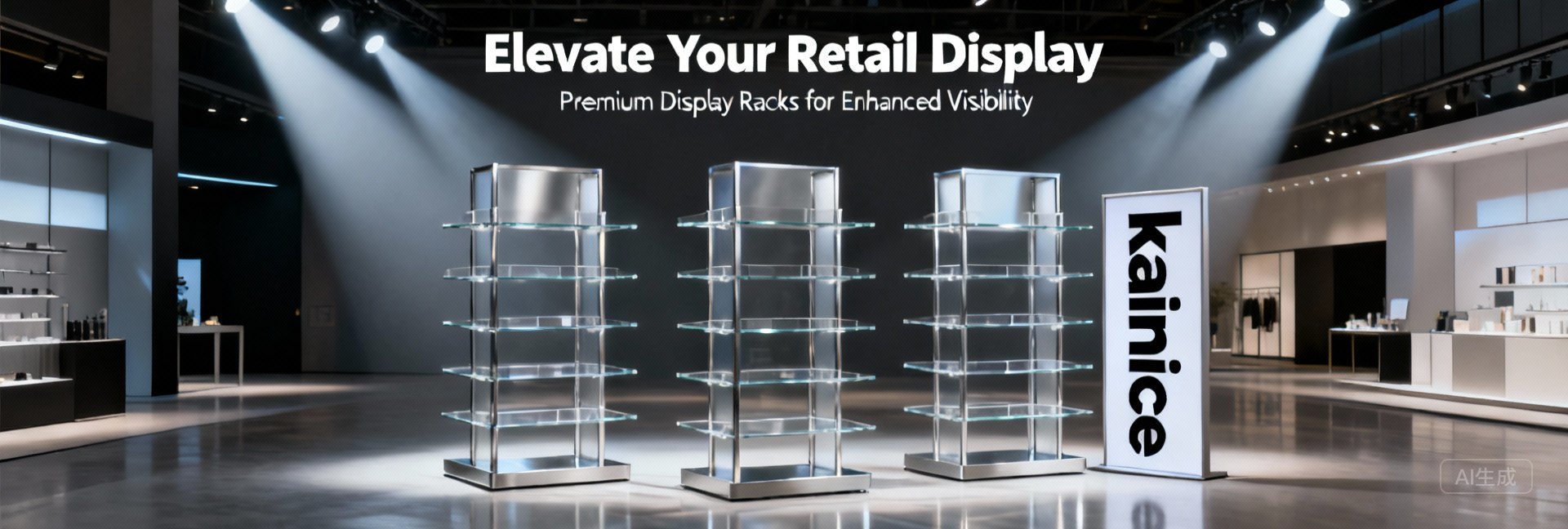
In high-traffic retail environments and modern commercial stores, selecting a heavy-duty, precision-crafted Retail Store Equipment directly impacts merchandise visibility and brand authority.
The Reality of Retail Fixture Manufacturing
I’ve spent the last 15 years on the shop floor, watching raw steel coils turn into high-end retail displays. Most people walk into a store and see a shiny rack holding sneakers or cosmetics. I look at the same rack and see the weld penetration, the powder coat adhesion, and the inevitable points of failure. Retail store equipment isn’t just furniture; it’s a structural system designed to sell product while surviving the absolute abuse of a high-traffic environment. If your displays aren't engineered for the worst-case scenario, you’re just waiting for a lawsuit or a damaged product claim. At kndisplay, we don't build "pretty" displays that fall apart after six months; we build structural systems that hold up under real-world retail pressure.Precision Engineering for Retail Store Equipment: Managing Laser Tolerances and Cold-Forming Defects
Ever wonder why discount display racks start wobbling after two weeks? It’s rarely the design; it’s the tolerance. When we run parts on our CNC fiber laser, we aim for a tolerance of ±0.2mm. Many shops claim they can hit this, but they fail the moment they switch to cold-rolled steel tubes. If you’re off by even 0.5mm, your modular assembly will fight you during installation. You’ll be forcing bolts into holes that don’t align, creating stress points that will eventually lead to fatigue cracks. I remember a project five years ago where we sourced a batch of high-tensile steel for a floor-to-ceiling display system. Because it was winter, the ambient temperature in the shipping container dropped significantly. When the client tried to assemble it, the cold-formed bends—which hadn't been properly stress-relieved—started developing microscopic cracks. It was a nightmare. We learned the hard way that you must account for material memory and bending radius. If your manufacturer isn't using precision jigs to hold alignment during the welding process, your displays will arrive looking like a parallelogram instead of a rectangle. At kndisplay, we mandate that every jig is checked against a master template every 50 units. If the jig is off by a hair, production stops. No exceptions.Material Selection Pitfalls in Retail Store Equipment: Virgin Polymers vs. Regrind and Structural Integrity
The biggest scam in the display industry is the use of "regrind" acrylics or recycled polymers in structural components. People try to save a few pennies by using plastic sheets that have been melted down and re-extruded. Here’s the kicker: regrind plastic loses its molecular chain integrity. Under the intense UV output of modern retail LED lighting, that plastic will turn yellow and become brittle within a year. When we manufacture acrylic risers or shelves, we strictly use cell-cast virgin material. Why? Because cell-cast acrylic has a higher molecular weight, offering better chemical resistance and structural rigidity. If you are using extruded acrylic for a shelf that needs to hold 10kg, it will bow. Period. Then there’s the powder coating. I’ve seen cheap shops skip the chemical pretreatment stage. They spray the powder directly onto the metal. It looks great for three weeks, but the moment a customer drags a metal shopping cart against it, the finish chips off like eggshells. We require a 60-80μm thickness for our powder coat, applied over a phosphate-treated surface. It’s the difference between a display that lasts five years and one that looks like garbage after one holiday season. Always ask your manufacturer for their salt spray test results. If they can’t provide them, run.Calculating Load Capacity for Retail Store Equipment: Avoiding Sagging and Shelf Failure
Load testing is where the boys are separated from the men. I’ve seen engineers calculate load capacity based on a static, dead-weight test. But retail isn't static. A customer pulls a heavy bottle of shampoo off a shelf, putting a dynamic, uneven load on the cantilevered bracket. That’s when the failure happens. We once had a client who insisted on using 22-gauge steel for a heavy-duty display shelf. Theoretically, it held the weight. But the shelf deflected by 12mm under load, making the entire display look cheap and unstable. We swapped it to 18-gauge steel and added a 20mm hemmed edge (a "brake-form" stiffener). The deflection dropped to under 2mm. That’s the difference between engineering and guessing. Is saving $3 on metal gauge really worth a $10,000 product spill? Never. When we design for kndisplay, we incorporate gussets at every high-stress junction. A gusset is a small, triangular piece of metal welded into the corner of a joint; it’s the cheapest way to add massive structural integrity. If your display doesn't have them at the load-bearing joints, it’s a ticking time bomb.Cost Breakdown and Maintenance of Retail Store Equipment: Preventing Freight Damage and Long-Term Wear
Packaging is the final frontier of manufacturing. You can build the strongest display in the world, but if it gets bent during freight, it’s useless. We’ve moved entirely to custom-cut pearl foam inserts that lock each component into place. It costs more than bubble wrap, but when you’re shipping across the ocean, you’re paying for insurance against disaster. Maintenance is another hidden cost. If you buy a "modular" system, make sure the components are actually interchangeable. We design our fixtures with universal hardware—standardized M6 or M8 bolts—so that if a piece gets damaged by a forklift, the store manager can swap it out without needing a specialized engineering team. Design-for-manufacture (DFM) is how we keep costs down without cutting corners. Instead of welding 20 separate pieces together, we use a single sheet of steel with multiple laser-cut slots and cold-formed bends. It reduces the weld count, which reduces the chance of human error, and it lowers the labor cost per unit. When you optimize the bending sequence, you’re not just saving money; you’re creating a more rigid, monolithic structure that doesn't rely on dozens of welds to hold it together. The goal is to move the complexity from the assembly line to the CAD file. If the engineering is done right at the start, the factory floor runs smooth, the client gets a rock-solid display, and nobody has to deal with the headache of a structural failure in the middle of a busy sales floor.
[Figure] Retail Store Equipment commercial showroom deployment & structural details (Fabrication: kndisplay)
Scene: Matte black powder-coated steel frames hold cantilevered solid oak shelves. Premium skincare is grid-aligned, illuminated by 3000K recessed spotlights. This 8k-rendered showroom features polished concrete floors, emphasizing precision craftsmanship and high-end retail store equipment.
💡 Factory Veteran Tip:
Every retail chain and storefront layout has distinct footprint constraints and load-bearing requirements. Before signing off on bulk Retail Store Equipment manufacturing orders, always demand certified load analysis drawings and a physical sample evaluation. At kndisplay, our engineering team provides free prototype evaluations and B2B fixture consulting for brands worldwide.