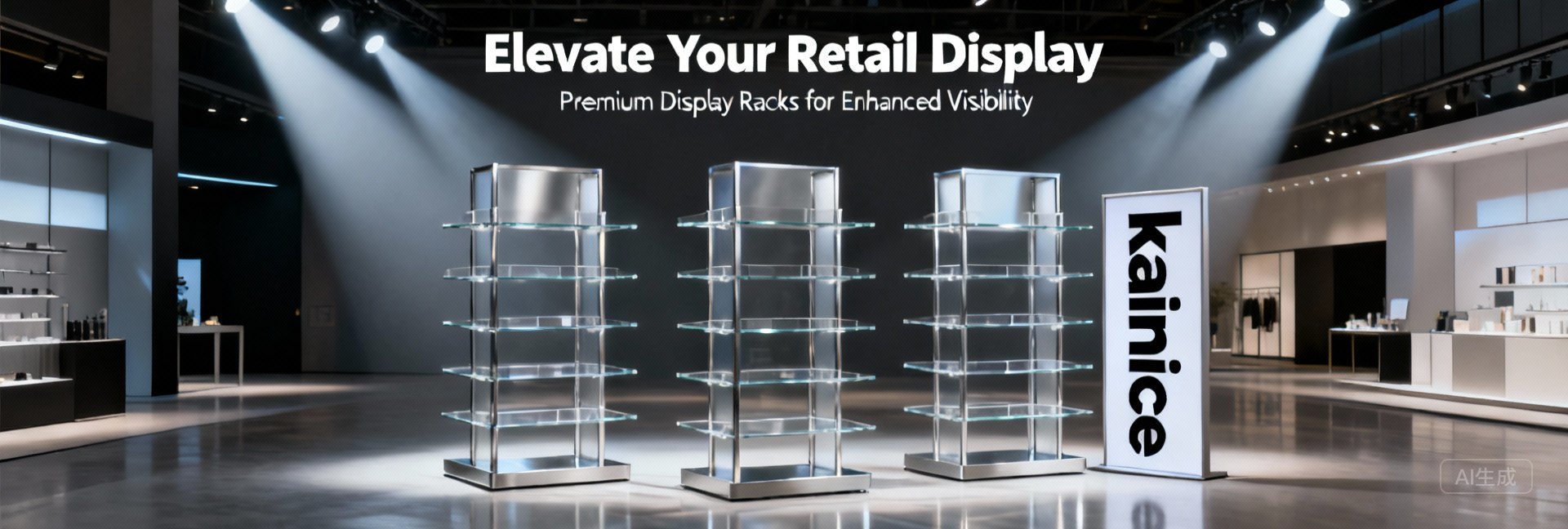
In high-traffic retail environments and modern commercial stores, selecting a heavy-duty, precision-crafted Metal Supermarket Shelf directly impacts merchandise visibility and brand authority.
Engineering the Backbone of Your Retail Space
I have spent fifteen years on the factory floor, watching steel coils turn into retail revenue. I have seen beautiful, high-end stores ruined by cheap, wobbling fixtures that look like they were built for a toy store. When you are buying a metal supermarket shelf, you aren't just buying metal; you are buying the safety of your customers and the integrity of your inventory. At kndisplay, we don't treat these as "racks." We treat them as structural load-bearing assets. If you aren't looking at the gauge, the weld penetration, and the finish microns, you are walking into a trap.Critical Load Capacity and Structural Integrity of Metal Supermarket Shelf Systems
Ever wonder why discount display racks start wobbling after two weeks? It’s usually a failure in understanding static versus dynamic loads. A shelf might hold 50kg when it’s perfectly still, but what happens when a customer pulls a heavy jar of pickles off the top tier? That sudden shift creates a force multiplier. If your shelf is built with 22-gauge steel, it will deflect. I remember a client who tried to save money by sourcing generic, thin-walled uprights for a beverage display. He loaded them with glass bottles. Within three days, the uprights developed a "banana" curve. The deflection was nearly 15mm. We had to rush out and replace the entire row with our kndisplay 14-gauge uprights. The difference? Our uprights have a box-section geometry that prevents torsion. When we test our shelves, we apply a 1.5x safety factor. If the shelf is rated for 100kg, we load it to 150kg and check for permanent deformation. If it doesn't return to zero-deflection, it doesn't leave the shop. Is saving a few dollars on metal gauge really worth a $10,000 product spill and a potential liability lawsuit?Cold-Forming vs Hot-Bending: Metal Supermarket Shelf Manufacturing Pitfalls
Here is a secret most manufacturers won't tell you: hot-bending is easier, but it ruins the molecular structure of the steel. When you heat metal to bend it, you soften the grain structure at the corner. That’s exactly where the weight is pressing down. The kicker is that the shelf will look fine on day one, but it will suffer from metal fatigue within six months. At our factory, we exclusively use cold-forming for our brackets and uprights. Cold-forming work-hardens the steel at the bend, actually increasing the tensile strength at the most critical stress point. We use CNC press brakes with precision-ground dies to ensure that every bend is crisp and consistent. If you see a shelf with a rounded, "soft" corner, that was likely a cheap hot-bend. It’s a ticking time bomb. We keep our bending tolerances at ±0.2mm. If a bracket is off by even half a millimeter, the entire bay will lean, and the shelves won't sit flush. That misalignment isn't just an eyesore; it creates uneven weight distribution that forces one upright to carry more than its fair share of the load.Avoiding Cosmetic and Structural Failure in Metal Supermarket Shelf Procurement
Freight is where most of the damage happens. If your shelves arrive with chipped paint, you are already behind. We use a proprietary pearl foam packaging system that isolates every upright and shelf panel. I’ve seen other factories use thin bubble wrap; that’s useless when a forklift driver drops a pallet. Low-grade steel is another headache. Many suppliers use "regrind" or scrap-mix steel that has hidden impurities. You won't see these until you try to powder coat them. The impurities cause "outgassing," which leads to tiny pinholes in your finish. Once oxygen hits those pinholes, the shelf starts rusting from the inside out within a year, especially in high-traffic stores where cleaning crews use harsh chemicals. At kndisplay, we source only virgin cold-rolled steel. We run a salt-spray test on every batch. If the finish doesn't hold up for 500 hours, we don't use the coil. You are paying for a premium finish; don't let a manufacturer cut corners on the substrate.Laser Tolerance and Powder Coating Standards for Premium Metal Supermarket Shelf Units
Precision isn't a luxury; it’s a requirement for assembly. We use fiber-optic CNC laser cutting for all our upright perforations. Why? Because mechanical punching wears down over time, leading to "burrs" and inconsistent slot sizes. If your slot is 0.5mm too wide, your shelf clip will have play. That play is where the wobble starts. The powder coating is the final line of defense. We aim for a consistent 60-80μm thickness. If it’s too thin, you get corrosion; if it’s too thick, it becomes brittle and flakes off when a shopping cart bumps into it. We use a multi-stage iron phosphate pretreatment bath before the electrostatic spray. This ensures the powder actually bites into the metal. I’ve walked into stores where the paint was peeling off in sheets because the manufacturer skipped the degreasing stage to save an hour of production time. Don't settle for "good enough." If you are investing in a store remodel, demand the technical specs. Ask for the micron rating of the coating and the gauge of the uprights. If they can’t give you a straight answer, walk away. Your store is your livelihood; build it on steel that actually holds up.
[Figure] Metal Supermarket Shelf commercial showroom deployment & structural details (Fabrication: kndisplay)
Scene: Matte black powder-coated steel shelving with brushed brass edges displays artisanal glass apothecary bottles. 3000K recessed LED spotlights highlight textures against a polished concrete backdrop. 8k commercial photography, soft depth of field, minimalist industrial showroom aesthetic, crisp architectural focus.
💡 Factory Veteran Tip:
Every retail chain and storefront layout has distinct footprint constraints and load-bearing requirements. Before signing off on bulk Metal Supermarket Shelf manufacturing orders, always demand certified load analysis drawings and a physical sample evaluation. At kndisplay, our engineering team provides free prototype evaluations and B2B fixture consulting for brands worldwide.