
A Floor Standing Clothing Rack is one of the most versatile fixtures in modern apparel retail. Unlike wall-mounted systems, it stands freely on the sales floor, so you can position it wherever your merchandising plan needs it — at the entrance, beside the fitting rooms, or as a mid-store focal point. For boutique owners, brand buyers, and wholesalers, the right freestanding unit affects far more than appearance: it shapes how customers move, how much stock you can present, and how smoothly your store runs every day.
This guide breaks down the main types, the materials that determine durability, and the practical details to confirm before placing a wholesale or OEM order.
What Is a Floor Standing Clothing Rack?
A floor standing clothing rack — also called a freestanding garment rack — is a self-supporting display fixture that combines a frame with hanging rails or arms, and often shelves, mirrors, or signage holders. Because it needs no wall anchoring, it suits almost any floor plan and can be rearranged for seasonal resets, promotions, and new collections.
Compared with fixed wall systems, freestanding clothing racks offer three practical advantages:
- Flexible placement — rework the sales floor without drilling or remodeling.
- All-around visibility — shoppers can browse from multiple directions, especially with four-way and round designs.
- Faster stock rotation — staff can restock and restyle displays during trading hours without tools.
Main Types of Floor Standing Clothing Racks
Different store formats call for different structures. The configurations you will encounter most often include:
- Single-rail racks — one horizontal hangrail on a simple frame; the go-to option for new arrivals, curated edits, and overflow stock.
- Double-rail (H-rack) units — two hanging levels that double capacity within the same footprint; ideal for basics, childrenswear, and high-SKU zones.
- Four-way racks — four arms on a central post, available with straight or waterfall (slanted) arms; a strong focal fixture for coordinated outfits and promotions.
- Round and half-round racks — circular rails that hold large volumes in a compact footprint; widely used in sale and clearance areas.
- Spiral racks — tiered, sculptural rails that present a tightly curated range with strong visual appeal.
- Rolling racks — the same structures fitted with lockable casters for pop-up shops, trade shows, and frequent layout changes.
Many of these designs can be combined with shelves, logo panels, or accessory trays, turning a simple rail into a multi-functional merchandising station.
Materials and Finishes That Determine Durability
Frame material is the biggest factor in how a rack performs after a year of daily use — and after a long ocean shipment.
- Carbon steel and stainless steel — the commercial standard for floor garment racks for retail stores. They carry heavy outerwear, resist deformation, and accept almost any finish.
- Aluminum — lighter and corrosion-resistant, well suited to mobile racks that staff move frequently.
- Wood and MDF — warm, boutique aesthetics; verify load ratings and moisture protection, especially for humid climates.
- Acrylic and mixed materials — a premium, gallery-like presentation for high-end concepts.
Finishes matter as much as frames. Chrome plating delivers a classic polished look with good scratch resistance, while black or custom-colored powder coating gives a matte, modern surface that resists chipping and carries your brand color. Beyond the catalog photos, ask about the details that predict lifespan:
- Tubing gauge and diameter — 18-gauge steel with 1"–1.25" hangrail tubing is a common retail benchmark.
- Weld quality at stress points — where legs meet the base and where brackets attach to the frame.
- Base construction — heavier garments call for cross-support or weighted bases that resist tipping.
Matching the Rack to Your Store Format
The best fixture is the one that fits your merchandise, floor plan, and operating rhythm — not necessarily the one that photographs best.
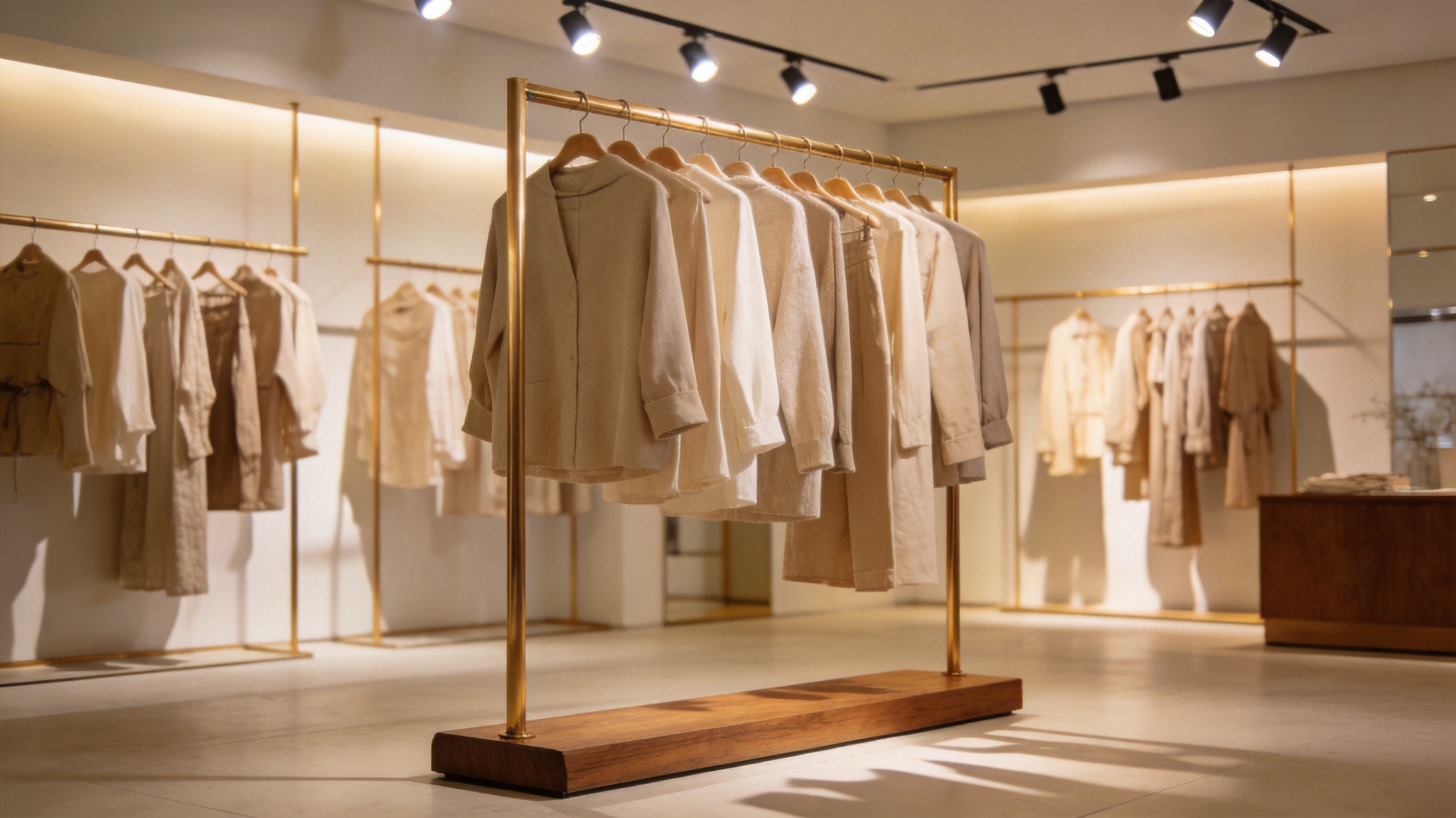
- Small boutiques — compact single-rail and slim four-way units keep sightlines open; brushed gold, matte black, or wood-metal hybrid finishes reinforce brand positioning.
- Chain and franchise stores — standardized freestanding garment rack systems cut per-unit cost, simplify installation, and keep every location visually consistent.
- Department and outlet stores — double-rail and round floor standing clothing racks maximize hanging density where stock volume matters most.
- Pop-ups and seasonal shops — rolling racks with knock-down (flat-pack) construction ship efficiently, install in minutes, and move as the layout changes.
Height should follow the garment, not the other way around. Allow roughly 55"–60" of hanging height for tops, 65"–70" for dresses, and up to 75" for gowns and maxi styles. Depth matters too: standard units run 19"–24" deep, and narrower profiles help in tight aisles where two shoppers need to pass.
Key Factors to Check Before You Order
Whether you are buying ten units for one boutique or several containers for a chain rollout, put these points on your checklist:
- Rated load capacity — ask for the static load rating in writing; a heavy duty floor standing clothing rack for winter coats needs a verified figure, not a marketing label.
- Dimensions and footprint — measure aisle width, doorways, and ceiling clearance before ordering, not after the container arrives.
- Mobility and adjustability — lockable casters, adjustable hangrails, and removable arms extend the fixture's working life across seasons.
- Customization options — finishes, logo plates, signage holders, and dimensions; an OEM/ODM manufacturer can often modify a standard frame without full custom tooling.
- MOQ, lead time, and sampling — confirm minimum order quantities, request a pre-production sample, and ask whether lead times shift in peak season.
- Export packaging — knock-down cartons save freight, and any wooden crates should be ISPM 15 certified for international shipments.
Questions to Ask Your Manufacturer
A reliable supplier answers these quickly and specifically, and the answers reveal more than any price list:
- What is the tested static load rating, and which tubing gauge does it use?
- Can finishes, heights, and logo elements be customized, and at what MOQ?
- Is a pre-production sample available, and how is quality controlled during mass production?
- How are the racks packed for export — knock-down cartons or certified crates?
- What spare parts and after-sales support are included after delivery?
Suppliers who hesitate on load ratings, welding quality, or export packaging usually show the same hesitation once your deposit is paid. Clear written answers at this stage protect your lead time, your budget, and the look of every store you open next — which is exactly what separates a well-sourced floor standing clothing rack program from an expensive guess.